

Validated WHM session context
The WHM CGI preserves the validated cp_security_token required by the native cPanel session. Existing request validation, taint mode and same-origin response boundaries remain in place.
A CSF/LFD-compatible firewall distribution with 51 verified security remediations, optional AI System Scan, protected panel workflows and report-first WebGuard across nine deployment paths.
DH20.29 / 15.10.32. Published: 2026-10-08T13:33:03Z. Documentation reviewed: 2026-10-08.
The 51 P-01–P-51 identifiers describe internal remediations, not 51 assigned CVEs. Static Messenger notices are supported; legacy reCAPTCHA self-unblock is disabled.
CVE-2026-65638 / CVE-2026-67402: exact-package assessment
This assessment applies only to the authentic reviewed package and its managed templates. It does not assess every installation or guarantee the absence of every vulnerability. Earlier releases are not assigned a status without separate verification.
Changelog JSON | Security JSON | OpenVEX | llms.txt | llms-full.txt
This release combines WHM context, LFD state and installer repairs with the regression fix found on canary. It supersedes DH20.28; the 51-item security register remains a separate count, without counting tests as vulnerabilities.
The WHM CGI preserves the validated cp_security_token required by the native cPanel session. Existing request validation, taint mode and same-origin response boundaries remain in place.
LFD compacts csf.temppids within its existing size and record limits, using LF_FLUSH to age process records. Accumulated temporary state no longer prevents normal tracking from recording new process identities.
The compatibility repair sets appropriate permissions only for public cPanel META modules. It does not broaden access across private configuration or the complete cPanel tree.
DH20.29 safely repairs a missing final LF in csf.resellers and corrects the shell error found on the canary. DH20.28 / 15.10.31 is superseded because its reseller repair path was faulty.
The comparison accepts a different listing order for independent chains while preserving rule order inside each chain and the remaining policy checks. Reordering independent chains alone no longer causes a false policy mismatch.
Maintainer qualification passed all 77 Linux test files. The autossltest2 canary update completed with CSF/LFD active and configuration preserved. The separately checked production host has passed dry-run only; this is not a production-upgrade claim.
Model choices offered by this release: gpt-5-mini, gpt-5.4-mini, gpt-5.6-terra. Availability depends on the administrator’s OpenAI API account.
Selected local security diagnostics are sent to OpenAI after activation. Recognised secret values are redacted, but this is not an anonymity guarantee. store=false is not a Zero Data Retention guarantee; the API account and provider data policies still apply. Optional API usage is billed separately from the free DCSF software. Findings need administrator review and do not guarantee that every security issue is detected.
Linux release qualification: 77/77. Public-bootstrap checks: 85/85.
Package 15.10.32 adds JSON::PP to installer preflight and the os.pl runtime check while preserving the separation between system Perl, cPanel private Perl and explicit CPAN fallback.
Outside cPanel, DCSF repairs the closed module list through exact RPM capabilities or Debian package mappings. DNF and YUM retain GPG verification, while APT rejects unauthenticated and insecure repositories.
The installer inventories required modules before preflight and after repair. Attempts are bounded, must make measurable progress and succeed only when the entire closed list imports again.
The system CPAN fallback is disabled by default. The operator must pass --allow-cpan-fallback; DCSF uses a fixed HTTPS MetaCPAN mirror, closed module names and validated work directories.
On cPanel, DCSF always validates /usr/local/cpanel/3rdparty/bin/perl, derives the matching versioned cpanm and explicitly invokes it through that same private interpreter without mixing /usr/bin/perl libraries.
OLSPanel requires JSON::PP. RPM selects the signed perl(JSON::PP) capability, Debian selects libjson-pp-perl, cPanel uses private cpanm and system CPAN still requires explicit --allow-cpan-fallback.
Canary PASS: An earlier public --dryrun canary authenticated the release under test, selected the correct installer and left every regular file directly below /etc/csf byte-identical.
Package 15.10.32 bounds the iframe to 640–1,200 pixels, scrolls it internally and returns it to the top after navigation. The masked modal, Watch System Logs, Search for IP and Firewall Allow remain visible while trusted-policy and real-backend checks are retained.
The modules directory is optional. Detection accepts only supported canonical roots and a safe root-owned /etc/olspanel/base_dir declaration.
Before writing, the adapter only reads metadata for /etc/csf, /etc/csf/csf.conf and /etc/csf/csf.cloudflare. --dryrun executes the same checks without changing files.
Symlinks, non-regular files, non-root ownership, group/world writable metadata and protected files with more than one hard link are rejected before installation with the exact failing path.
After installation, /etc/csf becomes root:root 0700 while csf.conf and csf.cloudflare become root:root 0600 with exactly one hard link. Existing contents remain byte-identical.
If csf.cloudflare is missing, it may be installed only from the verified signed package; an existing file is not replaced.
The generic installer stops when recursive chmod or chown fails instead of continuing to a PASS message.
A missing directory is created only during a real installation as root:root 0755. DCSF records privately that it created the path.
Uninstall removes the parent only when DCSF created it and it remains empty. Foreign or non-empty content is preserved.
Preflight and the os.pl runtime check require JSON::PP. Repair uses signed RPM capability perl(JSON::PP), Debian package libjson-pp-perl, cPanel private cpanm or the explicitly enabled system CPAN fallback.
After generic installation but before publishing or restarting panel integration, the adapter runs an isolated perl -T -c backend check. Failure stops OLSPanel integration.
OLSPanel serves images from the authenticated /usr/local/csf/lib/webmin/csf/images tree, where the signed package installs assets including csf.svg.
The backend loads /usr/local/csf/lib/ConfigServer/panel-action-policy.json with require_trusted => 1 instead of using the CyberPanel-specific default path. The complete parent chain and file must be root-controlled and non-writable by others.
The installer sends a bounded read-only binary request through the actual taint-mode backend. The response may not exceed 16 MiB and must contain the DCSF interface marker before integration is published or restarted. After the extmail.uck.katowice.pl upgrade, the complete Django-to-Perl-backend path returned HTTP 200.
Protected actions use a dedicated modal with a bounded type="password" field instead of window.prompt(). Escape, the cancel control and backdrop cancellation safely stop the operation, and the visible field is cleared immediately after the credential is handed to the request.
Search System Logs and Watch System Logs accept only a one-to-twenty digit nocache value. Progress ends after every response, failed requests display their HTTP status, and live search and watch checks returned HTTP 200.
Intercepted navigation is deduplicated, deferred to the next event turn and explicitly submitted to _self with visible progress. Quick Allow and configuration save retain a complete nonempty response instead of an empty frame.
Tests through the real Perl backend found the newly added address, displayed the Firewall Allow list and returned normal Done and Return controls. The temporary entry was removed and the final csf.allow digest exactly matched its pre-test value.
The action iframe stays between 640 and 1,200 pixels, scrolls long content internally and returns to the top after every navigation. The live test kept the outer page at 1,000 pixels with scroll position zero, so Search for IP, Firewall Allow, Watch System Logs and the reauthentication modal remained visible.
The figures preserve each project’s published methodology. When a release maintainer has not disclosed a security-fix count, the table says so instead of inventing a value.
| Line and release | Explicitly counted security fixes | Other fixes or controls | Comparison evidence |
|---|---|---|---|
| DCSF DH20.29technical package 15.10.32 | 5151 of 51 individually documented and verified remediations | 3 controls + Perl + OLSPanel + WebGuardDH20.29 qualification: 77 of 77 gates | Public P-01–P-51 registerImplementation, regression test and release qualification |
| cPanel CSF 16.31-1cPanel & WHM-only release | Not disclosedThe maintainer did not publish a fix count for 16.31-1 | 16.30-1: 4 + 54 security fixes and 5 stability or compatibility fixes | Official cPanel change log16.31-1 is described as a Targeted Security Release |
| Aetherinox CSF 15.10public compatibility baseline | 2Items directly addressing XSS or untrusted-input encoding | 11 listed fix itemsTotal fixes in the public release summary | Official 15.10 release notesNo equivalent numbered security-remediation matrix |
DCSF: 13 September 2026; comparison sources: 10 September 2026. Methodology: DCSF counts independent security requirements closed by implementation and testing. For other releases, only figures explicitly published by their maintainers are shown. Fix items, security gates and CVE identifiers are not equivalent units.
DCSF preserves the familiar CSF and LFD workflow while closing exploit classes around root execution, untrusted parsers, remote updates, panel authorisation and firewall state.
Release metadata binds version, package name and cryptographic digest to a pinned signing key.
Shell-free execution and explicit validation reduce ambiguity where firewall administration crosses privilege boundaries.
Network, file and log inputs are processed with size, time and structure limits.
Changes are designed for staged validation, deterministic failure and recoverable firewall state.
Closed authenticated actions, CSRF protection, password re-authentication and shell-free bounded execution protect the new panel path.
Bounded replay, audit and correlation detect per-vhost overload without placing foreign-owned web logs inside the LFD parser.
A compact header, readable status stack, clear controls, dark mode and responsive tables improve daily administration.
This release retains caps on replay, audit volume and correlation cost, while an isolated service copies validated OpenLiteSpeed evidence. WebGuard runs outside the LFD regex parser and remains disabled in report mode by default.
Adapters accept only canonical vhosts or configured aliases. In verified cPanel EA-Nginx, nginx on 80/443 supplies client IP; Apache on 81/444 supplies backend load, never the local proxy peer as a blocking candidate.
Replay accepts at most 50,000 input lines, 30 seconds and 2,000 emitted audit records, and reports whether the result is complete.
Audit buffers are capped, quadratic scans are avoided and out-of-order source timestamps cannot corrupt the rolling vhost window.
A root service copies only the validated OLS log into a 256 MiB-capped DCSF file rotated at 128 MiB, outside the foreign-owned log tree.
WEBGUARD=0 and WEBGUARD_MODE=report keep both the engine and optional collector disabled until an operator validates the evidence.
Enforce mode can create only temporary exact-IP, inbound, listener-port-specific DCSF actions and protects allow, ignore, monitoring and trusted proxy or CDN ranges.
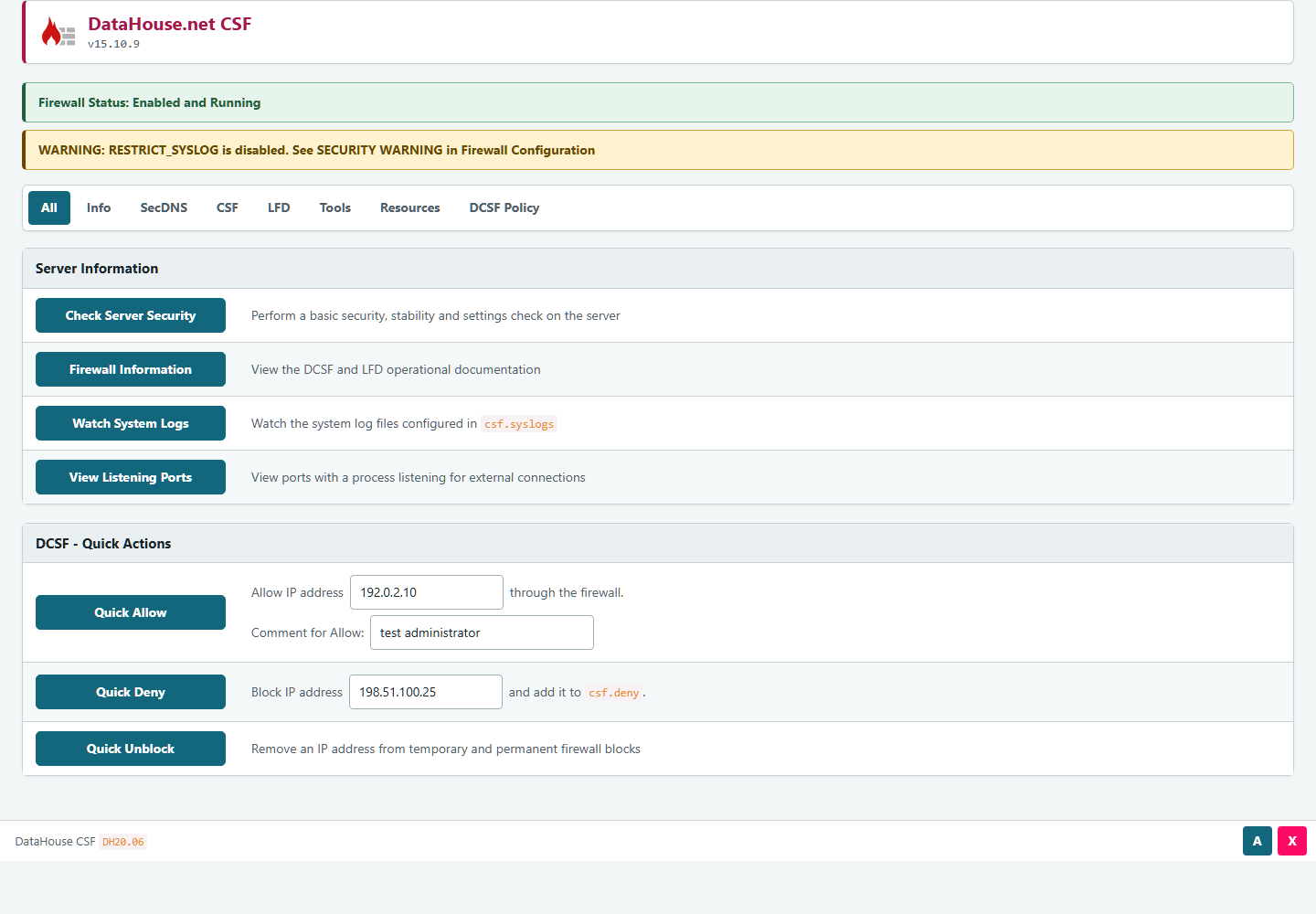
Administrators retain the recognisable CSF/LFD operational model in a refreshed responsive interface. DCSF adds signed distribution, strict validation, bounded processing, transactional recovery and report-first WebGuard correlation underneath it.
DCSF supports eight hosting-panel integrations, including a bounded OLSPanel action viewport, repaired authentication, logs and firewall workflows, cPanel private-Perl handling, plus a generic Linux mode for direct administration.
Preserves WHM workflows and backup-first RPM migration. Verified EA-Nginx uses nginx on 80/443 for client IP and Apache on 81/444 for backend status. Dependency repair keeps /usr/local/cpanel/3rdparty/bin/perl separate from system Perl.
Keeps the OLSPanel action iframe between 640 and 1,200 pixels with internal scrolling and top reset, so masked reauthentication, Watch System Logs, Search for IP and Firewall Allow remain visible.
Uses the established DirectAdmin adapter with hardened argument validation, identity transitions and shell-free privileged execution.
Retains the CyberPanel integration while restricting privileged mutations to authenticated, CSRF-protected POST actions.
Supports the existing Control Web Panel administration path with the same signed package, parser limits and firewall-state safeguards.
Integrates with NodeWorx and enforces native FIREWALL authority, blocking secondary accounts that do not hold that permission.
Keeps the VestaCP CSF/LFD integration path while applying the common DCSF release, input-validation and recovery controls.
Supports CSF/LFD administration through Webmin with the same hardened backend and signed update channel.
Provides direct operation on supported RHEL- and Debian-family servers. Missing closed-list Perl modules are repaired through GPG-verified RPM capabilities or authenticated APT package mappings.
The DataHouse Threat Feed is continuously refreshed through a controlled pipeline designed to reject malformed, stale and duplicate records.
Receive indicators from curated operational and research sources.
Confirm syntax, address scope, provenance and transport integrity.
Canonicalise records and eliminate duplicate or conflicting entries.
Expire indicators whose confidence or operational relevance has decayed.
DH20.29 maps to signed package 15.10.32: validated WHM session context, bounded csf.temppids compaction, public-only cPanel META permissions, corrected reseller-file repair and equivalent nftables policy comparison. All 77 Linux test files passed and the autossltest2 canary update succeeded. DH20.28 is superseded. Optional AI System Scan, the LFD exclusion editor and public download resources are retained.
The signed public package and installer are available.
Key information about the current production release.
An optional quick or deep security review of a bounded local snapshot. It is disabled by default and requires your own OpenAI API key. Results must reference supplied evidence IDs, remain advisory and do not automatically run repairs.
The DCSF software remains free under GPLv3, at USD 0. Optional OpenAI API usage is billed separately to the administrator’s API account. Selected diagnostic data is sent to OpenAI; store=false is not a Zero Data Retention guarantee.
Yes. DH20.29 is the latest hardened release in the DCSF line. It maps to signed technical package 15.10.32, carries 51 verified security remediations and passed all 77 release gates.
RPM systems select the signed perl(JSON::PP) capability and Debian systems select libjson-pp-perl. cPanel uses its validated private Perl and matching cpanm; system CPAN remains disabled unless the operator explicitly supplies --allow-cpan-fallback.
The backend uses the explicit shared path /usr/local/csf/lib/ConfigServer/panel-action-policy.json with require_trusted => 1. The complete parent chain and policy file must remain root-controlled and non-writable.
After generic installation and before publishing or restarting panel integration, the adapter runs perl -T -c and sends a bounded read-only binary request through the actual taint-mode backend. The response is limited to 16 MiB and must contain the DCSF interface marker.
Protected OLSPanel actions use a dedicated modal with a bounded type=password field instead of window.prompt(). Escape, cancellation and backdrop cancellation are supported, and the visible field is cleared immediately when the protected request receives the credential.
Search System Logs and Watch System Logs accept only a one-to-twenty digit nocache value and always clear their progress state. Deferred, deduplicated _self navigation preserves results after Quick Allow, configuration save, Search for IP and Firewall Allow.
The action iframe stays between 640 and 1,200 pixels, scrolls internally and returns to its top after every navigation. Search for IP, Firewall Allow, Watch System Logs and the centered masked reauthentication modal therefore remain inside the visible operator viewport.
OLSPanel images, including csf.svg, are served from the authenticated package tree at /usr/local/csf/lib/webmin/csf/images.
Before package installation, the adapter performs a read-only metadata preflight for /etc/csf, /etc/csf/csf.conf and /etc/csf/csf.cloudflare. It rejects symlinks, unsafe hard links and unsafe metadata with an exact-path diagnostic, then normalizes the directory to root:root 0700 and protected files to root:root 0600 without changing existing contents.
DCSF supports OLSPanel, cPanel & WHM, DirectAdmin, CyberPanel, CWP, InterWorx, VestaCP and Webmin, plus a generic mode for supported RHEL- and Debian-family Linux servers.
The public register covers command and argument injection, ReDoS and resource exhaustion, file races, update-chain substitution, web-panel abuse, cluster spoofing and replay, process identity bypasses, DNS trust errors and firewall-state loss.
WebGuard is an optional, disabled-by-default service that correlates costly or stalled requests with saturation of the same canonical virtual host. DH20.29 retains bounded replay, isolated OpenLiteSpeed log collection and temporary exact-IP, listener-port-specific enforcement.
Yes. DH20.29 is public and maps to the signed DCSF 15.10.32 package. The bootstrap verifies every trust-bearing artifact before installation.
DCSF publishes 51 individually verified security remediations plus three operational controls. cPanel does not disclose a fix count for its targeted 16.31-1 security release. The Aetherinox 15.10 release summary lists 11 fix items, including two directly focused on XSS or unsafe input rendering; these release-note items are not equivalent to DCSF security gates.